
Herringbone for a working driveway
Pavers set in a zigzag lock against each other in every direction, so they hold best where cars turn and back out every day. It's the pattern I steer most people toward for the main part of a driveway.
Cracked, heaved or tired concrete out front? We check the old slab, pack the ground right and lay pavers that hold flat under your cars.
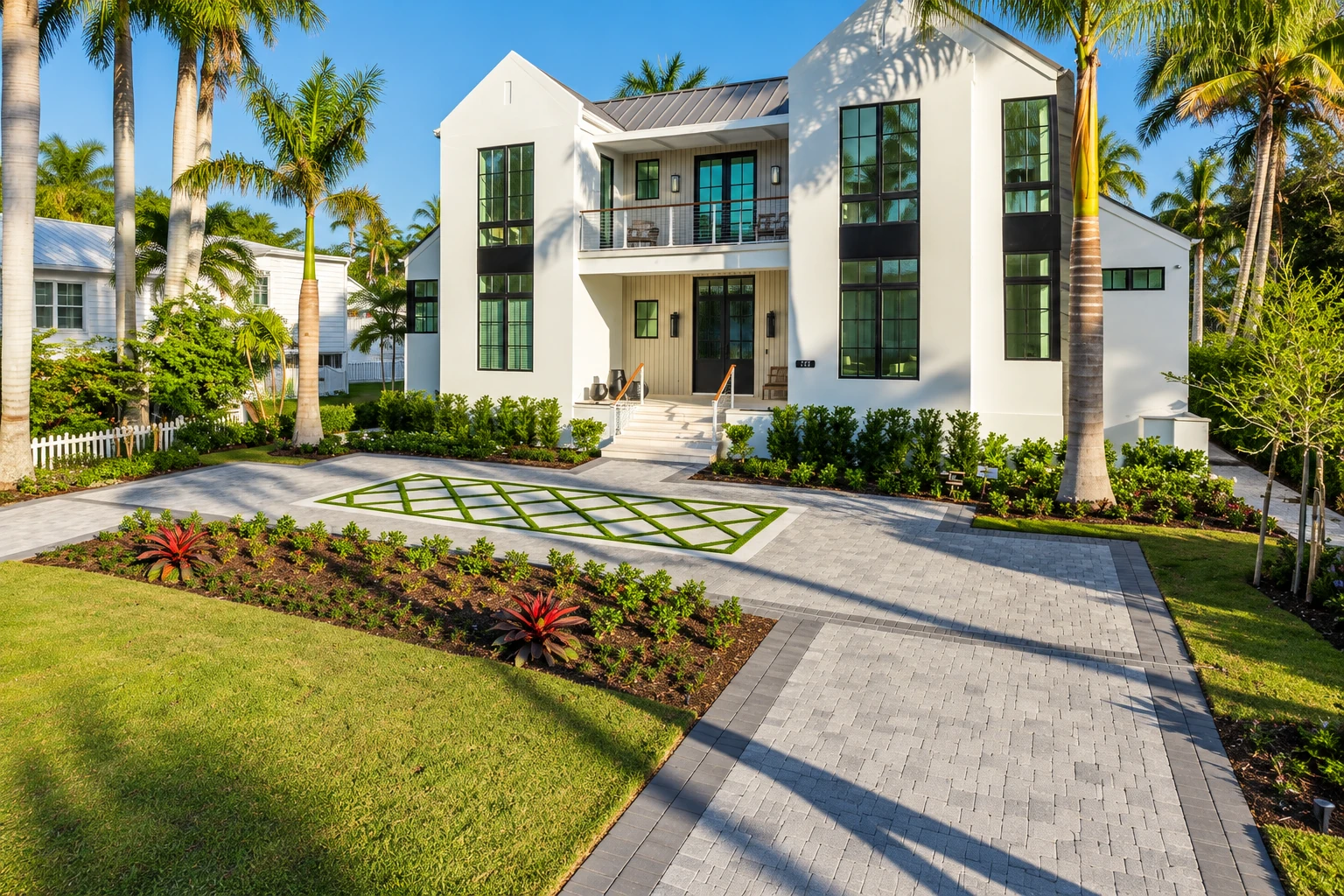
Driveway pavers in Escondido give you a new driveway made of interlocking concrete pavers set on a packed base and held tight at the edges, so it carries your cars and lets you lift and reset a few pavers later instead of breaking out a whole slab.
Most folks call us after the old concrete has cracked across, been lifted by a tree root or started holding water by the garage, and they want to know whether pavers can go right over it or the slab has to go. The price mostly moves with the size of the driveway, whether the old concrete comes out, the paver and pattern you pick and how much digging the ground needs. The schedule turns on that same tear-out, plus a city permit if the work reaches the street. When I come out, I'll look at all of that with you and put your number in writing.
I come out to look at every job myself, so the person reading your slab is the one making the plan. Then I'm on site running our crew while the work gets done, so the base gets packed the way we talked about.
I spent years as another mason's right hand, running jobs and learning the trade on the tools, before I started out on my own here in 2020. Six years in, I'm still on the tools most days, not just behind a desk.
We're licensed and insured, which matters on a driveway job, where heavy equipment works close to your house, your cars and the street. Ask about it when I come out, and I'll show you before you decide anything.
If your slab is sound, I'll tell you, and if pavers aren't worth it for your house, you'll hear that too. Satisfaction guaranteed. When you're ready, call (760) 546-4075 or use the form below, and I'll come take a look.
Send the form or call, and we'll get back to you within one business day to set up a free on-site estimate, with no pressure to book. I'll walk your driveway with you, look over the old slab and put the estimate in writing. It helps to have the driveway's rough size and a few photos of any cracks or heaving ready.
Most of a driveway sits on your lot, but if the work reaches into the city's right-of-way, the public strip along the street, you'll need an encroachment permit, which is the city's okay to work on public land. The city's field engineering office handles those, and the city's rules call for a traffic control plan for any work in the right-of-way and a contractor who holds a City of Escondido business license and a valid state contractor's license for the work. If your job needs a permit, we handle the application with the city or county and meet the inspector when the time comes.
Around Escondido we see plenty of older concrete drives that have cracked at the joints or been pushed up by a tree, along with newer homes where folks just want something better than plain gray. We're based in Escondido and do the same work in the cities around it, from San Marcos and Valley Center to Temecula and Murrieta and down to Chula Vista, plus plenty of places beyond the ones on our city pages.
Across the US, a paver driveway usually costs about $10 to $30 per square foot installed, and that's a national guide figure, not our price. Tearing out an old concrete driveway adds to the cost per square foot on top of the new pavers. Your own number comes from the written estimate after I measure and look at your slab.
Sometimes they can, because thin overlay pavers can go on top of a concrete driveway that's level, stable and in decent shape. If yours is cracked, heaving or has drainage problems, taking it out is the better investment, since pavers laid on a bad slab end up with its problems. That's the first thing I check when I come out.
They work best where the water running across your yard isn't carrying much dirt and there isn't a lot of windblown dust, because both can clog the gaps quickly. The city's storm water design guidance lists permeable pavement as one of its examples, alongside rain gardens and rain barrels. One paver maker rates the pavers in its permeable systems for a 50-year design life, based on how they've held up in the field.
You need one when the work reaches into the city's right-of-way along the street, as covered above. Approval can take anywhere from 4 to 6 working days up to several weeks, depending on the kind of application and whether it was complete when it went in. That's why we send in a complete application, so the permit doesn't hold up your driveway.
Poorly packed soil under the base is the usual culprit, because good compaction is what keeps settling to a minimum. When you compare quotes, ask each crew exactly how they'll compact the soil. On clay or other slow-draining ground that carries cars, the paver industry's guidance recommends drain pipes too.
Start with an estimate, where I measure, look at the old slab and talk through pattern and color with you. Before anyone digs, we check with the utility companies so buried pipes and wires get marked, and in many places that's one phone call made at least two days ahead. After that, the schedule mostly turns on whether the old concrete comes out and whether part of the work needs a city permit.